In-House Team vs Remote Developers: Full Cost & Control Comparison
Choosing between an in-house team and remote developers is a crucial decision. This guide breaks down the real debate by comparing their fully loaded costs, hiring speeds and day-to-day control so you can choose wisely. You will get a clear and honest look at both models so you can pick the right path for your business.

“Furqan Aziz is CEO & Founder of InvoZone. He is a tech enthusiast by heart with 10+ years ...” See more
Don’t Have Time To Read Now? Download It For Later.
Table of Contents
- The Real Cost of an In-House Developer
- What Actually Goes Into an In-House Developer's Cost?
- The Real Cost of a Remote Developer
- Side-by-Side Cost Comparison
- Table 1: All-In Cost Comparison Overview (Per Developer, Annually)
- Table 2: Monthly Cost Breakdown (5-Person Team)
- Quick Reference Card
- Control: What Do You Actually Own?
- Table 3: Control & Operational Comparison
- Speed: How Fast Can You Get Started?
- Security and Intellectual Property
- Productivity and Performance
- Team Culture and Retention
- The Hybrid Approach: Best of Both Worlds
- How to Skip the Hiring Grind with InvoZone
- A Final Thought
You have already spent weeks writing job descriptions, posting on LinkedIn, and screening resumes. You are three interviews in and the candidate does seem great.
You are starting to wonder if this is actually the right way to hire. Maybe you should have gone remote? Or you should have hired a whole team instead of bringing people in one-by-one?
You are not alone. This is where every hiring manager gets confused.
Both setups can succeed and both can fail.
This blog shows you the real, honest differences between both paths. Weighing the pros and cons when hiring in-house vs. remote developers is essential as the choice you make directly impacts your budget, timeline, and daily operations.
Let’s get into it.
The Real Cost of an In-House Developer
Here is the number that should make you pause: base salary represents roughly 60% to 70% of the total cost of an in-house employee. The other 30% to 40% is everything else and most hiring managers forget to budget for it.
While a senior developer in a major US tech hub earns a base of $90,000 to $140,000 per year, that is merely the starting point. In high-cost markets like San Francisco, that number climbs to $120,000–$250,000 once benefits and office overhead are factored in. To evaluate whether this investment aligns with your budget, one should have knowledge on the breakdown of the costs to hire a remote software developer to see the baseline comparison.

What Actually Goes Into an In-House Developer's Cost?
Before you decide to scale your engineering team with remote talent, it is essential to look at what local hiring actually costs. Hiring locally means you need to factor in these six major overhead expenses
Salaries and Benefits
Typically add 20% to 40% above base salary for health insurance, retirement contributions, and payroll taxes.
Recruiting and Onboarding
The average recruitment cost for a single developer is approximately $4,700, with an additional $3,000–$5,000 for onboarding. For senior roles, recruitment fees alone run 15–25% of the first-year salary and the process takes upwards of 40 days. One should optimize their remote developer interview process to filter out unqualified candidates before they waste your technical team's time.
Office Space and Infrastructure
In major tech hubs, physical office space adds $10,000 to $20,000 per developer annually before buying their laptop, monitors, desk, chair, and snacks.
Management Overhead
Project management, QA, operations, security, and the hours your senior engineers spend mentoring and reviewing code instead of writing it.
Attrition and Knowledge Loss
Tech turnover is notoriously high. When a developer leaves, you lose product context, domain knowledge, and undocumented fixes. Replacing an in-house engineer can easily cost 50% to 150% of their annual salary in lost momentum and search fees.
The Fully Loaded Reality
The fully loaded cost of an in-house developer is typically 1.5 to 2.4 times their base salary once you factor in local taxes, equipment, benefits, and physical overhead.
Suddenly, a $120,000 in-house salary becomes an active $180,000 to $288,000 annual expense.
The Real Cost of a Remote Developer
A remote developer in Eastern Europe typically earns $50,000–$80,000 per year. Latin America and Southeast Asia are even more budget-friendly (a mid-stack developer in Poland averages $55,000; in Argentina, it is around $42,000). You need to weigh regional developer density, English proficiency, and local infrastructure by looking at the best countries to hire remote developers.
What You Do Not Pay For
No office space
Remote developers work from their own environments. Zero spend on desks, chairs, physical space, or office maintenance.
No benefits & payroll taxes
You are not paying local health insurance, retirement contributions, or payroll taxes. Your development partner or Employer of Record (EOR) handles that.
Lower recruitment costs
Partnering with platforms that offer pre-screened talent shortens hiring cycles by up to 50%. This spares you tens of thousands in agency fees.
Flexible contracts
Month-to-month arrangements mean you can scale your team size up or down with the flow of your project. There are no severance packages or legal liabilities.
What You Do Pay For
Vendor rates
All-inclusive hourly or monthly fees for the developers. These are typically 40% to 90% lower than Western in-house fully loaded costs.
Oversight & coordination
The time your internal lead spends on backlog reviews, architecture alignment, and sprint check-ins.
Collaboration tooling
Slack, Zoom, Jira, and communication software. (Typically $3,000–$5,000 annually for a 5-person team).
EOR or compliance fees
If hiring directly through an Employer of Record, expect $300–$700 per employee per month.
The bottom line
a 5-person remote team typically costs $25,000–$45,000 per month. The equivalent in-house team in the US runs $80,000–$150,000 per month.
Side-by-Side Cost Comparison
To see exactly where your capital is moving, let’s look at the numbers side-by-side.
Our first comparison table maps out the annual, all-in cost per single developer. It details how benefits, taxes, workspace, and recruiting fees amortize over a year, giving you the actual fully loaded expense for an in-house US developer versus various remote regions.
Table 1: All-In Cost Comparison Overview (Per Developer, Annually)
|
Cost Component |
In-House (US Senior) |
Remote (Eastern Europe) |
Remote (Latin America) |
Remote (India/SE Asia) |
|
Base salary |
$120,000–$180,000 |
$50,000–$80,000 |
$42,000–$65,000 |
$25,000–$40,000 |
|
Benefits (health, 401k, PTO) |
$20,000–$40,000 |
Included in vendor rate |
|
Payroll taxes |
$8,000–$15,000 |
Included in vendor rate |
|
Equipment & workspace |
$5,000–$15,000 |
$0–$500 (remote setup) |
$0–$500 |
$0–$500 |
|
Recruiting cost (amortized) |
$5,000–$15,000 |
$0 (pre-vetted) |
$0 (pre-vetted) |
$0 (pre-vetted) |
|
Management overhead |
$10,000–$20,000 |
$0–$5,000 (vendor handles) |
$0–$5,000 |
$0–$5,000 |
|
Training & development |
$2,000–$5,000 |
Included in vendor rate |
|
Total annual cost |
$170,000–$290,000 |
$50,000–$85,000 |
$42,000–$70,000 |
$25,000–$45,000 |
A $120,000 base salary becomes $180,000–$210,000 in total annual cost.
The Bottom Line
Do not let raw base salary headlines fool you. When you look at the total annual cost, the premium you pay for in-house talent is for the skill set as well as for the office, the benefits, and the recruiting machine. If your goal is maximizing pure engineering output, the remote model offers a significantly higher "utility-per-dollar" ratio.
Table 2: Monthly Cost Breakdown (5-Person Team)
Let’s look at how the monthly costs stack up when you scale models to a 5-person team
|
Cost Category |
In-House Team |
Remote Team (Nearshore) |
Remote Team (Offshore) |
|
Developer Salaries (5 × monthly) |
$50,000–$75,000 |
$18,000–$30,000 |
$10,400–$16,600 |
|
Benefits & Payroll Taxes |
$12,000–$20,000 |
$0 (included) |
$0 (included) |
|
Office Space (5 seats) |
$4,000–$8,000 |
$0 |
$0 |
|
Equipment & Software |
$1,500–$3,000 |
$500–$1,000 |
$500–$1,000 |
|
Recruiting Amortization |
$2,000–$5,000 |
$0 |
$0 |
|
Management Overhead |
$4,000–$8,000 |
$1,000–$2,000 |
$1,000–$2,000 |
|
Monthly Total |
$73,500–$119,000 |
$19,500–$33,000 |
$11,900–$19,600 |
|
Annual Total |
$882,000–$1,428,000 |
$234,000–$396,000 |
$142,800–$ |
The Takeaway
While a nearshore team saves you roughly 60% to 70% compared to US in-house, going offshore can cut your annual burn rate by up to 80% to 85%. The choice comes down to whether you are willing to pay a slight premium for real-time, same-time-zone collaboration.
Quick Reference Card
|
Metric |
In-House |
Remote |
|
Annual cost per developer |
$170,000–$290,000 |
$25,000–$85,000 |
|
5-person team monthly cost |
$73,500–$119,000 |
$19,500–$33,000 |
|
Time to hire |
41–82 days |
1–2 weeks |
|
Time to full productivity |
3–6 months |
1–2 weeks |
|
Turnover rate |
13–20% |
12–18% |
|
Cost savings vs in-house |
— |
40–60% |
|
Management burden |
High |
Low |
|
Control |
Full |
Contractual |
Control: What Do You Actually Own?
Here is where the trade-off gets real: In-house teams give you the illusion of physical oversight; remote teams force you to build actual operational control.
With an in-house team, you can walk over to a desk, see who is working, and get instant feedback. You retain deep, direct day-to-day control over the tech stack, security protocols, and culture.
With a remote team, you cannot monitor desks. You must depend on async communication, highly documented processes, and objective-based tracking. However, as noted in Stanford research, remote developers are up to 13% more productive on individual focus tasks because they are spared office distractions and commute fatigue, allowing them to be measured entirely by what they ship. To set your team up for success, it is vital to know the key strategies and pitfalls of remote management to ensure productivity with developers and set up your next project for absolute success.
Our next comparison table breaks down how control, visibility, and intellectual property ownership differ between the two models.
Table 3: Control & Operational Comparison
|
Factor |
In-House Team |
Remote Team |
|
Daily management |
You manage everything |
Vendor manages day-to-day |
|
Code ownership |
Full internal control |
Contractual protection |
|
IP protection |
Strong (physical control) |
Requires NDAs and contracts |
|
Cultural alignment |
Strong |
Variable |
|
Collaboration |
Immediate, in-person |
Async, tool-dependent |
|
Scalability |
Slow (3–6 months to hire) |
Fast (1–2 weeks) |
|
Management overhead |
High |
Low (partner manages) |
|
Domain knowledge |
Deep over time |
Requires deliberate onboarding |
|
Visibility into work |
Direct (you see them) |
Requires output-based tracking |
|
Communication |
Face-to-face |
Slack, Zoom, async tools |
Speed: How Fast Can You Get Started?
This is where the gap is most dramatic.
Building an in-house team takes 3 to 6 months of writing specs, screening resumes, running technical loops, and waiting out notice periods.
By contrast, using a pre-vetted remote talent partner like InvoZone drops that time to 1 to 2 weeks. You get matched with pre vetted developers in as little as 24 hours. If you have a limited runway, this speed difference is the difference between launching or shutting down.
Security and Intellectual Property
This is the area where in-house teams have a clear advantage.
In-house teams make compliance easier because they work inside your physical network.
Remote work introduces significant vulnerabilities. IP protection is more challenging in distributed teams. Company data is more exposed. Confidential information is harder to track and ensure it is completely deleted from local devices.
Remote setups require robust infrastructure investments such as endpoint protection, forced multi-factor authentication, secure VPN networks, and strict NDAs to protect sensitive IP. The key question is not "Is remote secure?" but rather "Are you willing to set up the basic security tooling to make it secure?"
Productivity and Performance
The data on productivity is surprisingly clear.
Remote workers often outperform their office-based peers. A 2023 Stanford University study found remote developers to be more productive than their office-based peers, attributing this to fewer distractions and improved focus. Remote workers average 52% focus time compared to 46% for in-office teams as they work flexible hours that align with peak productivity times.
Remote teams operating across multiple time zones enable "follow-the-sun" workflows where work progresses almost around the clock.
But there is a catch. On-site workers demonstrate superior collaboration and communication in some studies. Informal, spontaneous collaboration is harder to replicate over Zoom.
The gap narrows with the right tools and processes. Modern collaboration tools Slack, Jira, Zoom have minimized the communication gap for disciplined teams.
Team Culture and Retention
In-house teams build culture naturally. Organic discussions, impromptu brainstorming, stronger personal connections. Full cultural alignment with company values. Easier onboarding into proprietary systems.
Remote teams require intentional effort to build culture. You cannot rely on watercooler conversations. You have to schedule virtual coffee chats, plan annual meetups, and deliberately create space for relationship-building.
But remote work has advantages too. Remote developers are more satisfied with their roles, reducing attrition. No commute, flexible hours, and better work-life balance. Remote workers are more likely to feel their companies have a collaborative and communicative culture than their in-office counterparts.
Turnover tells a clear story. In-house developer turnover averages 13-20% annually. In-office tech team retention hovers around 70% annually compared to 45% for remote gigs.
Remote developers leave more often. But they also cost less to replace and are easier to find.
The Hybrid Approach: Best of Both Worlds
Here is what the smartest companies are actually doing.
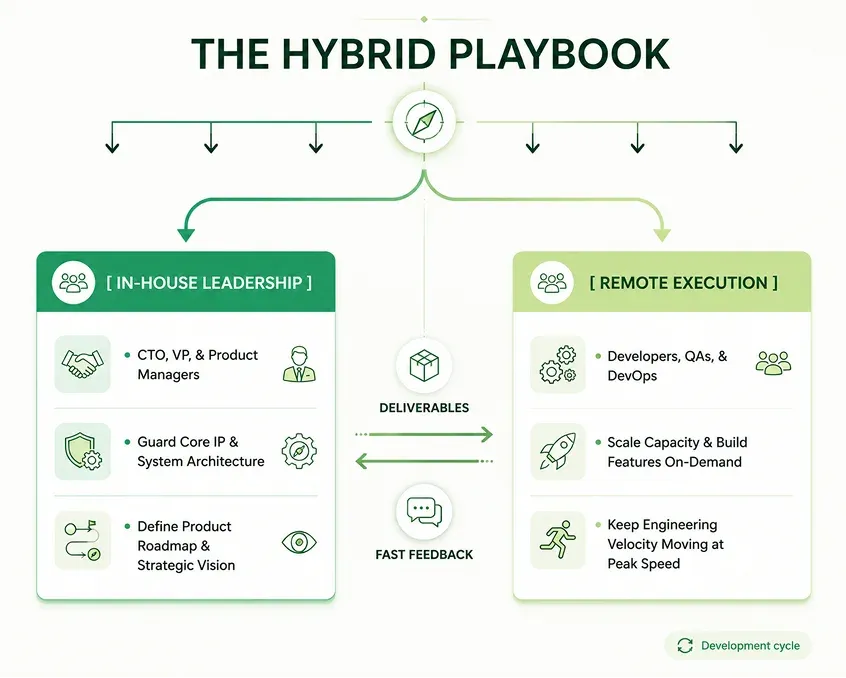
The smartest engineering teams do not choose one model exclusively. They use a hybrid model: keeping product architecture, strategy, and security in-house, while leveraging remote developers to scale execution speed.
When to Choose In-House
Choose in-house when:
- Your product itself is your competitive moat. You need tight control over IP and architecture.
- You have multi-year budgets for stable payroll.
- You require tight domain expertise daily.
- You are building a founding engineering team that defines company culture.
- Your industry has strict regulatory requirements that mandate on-site presence.
- The role is CTO, VP Engineering, or another core leadership position.
When to Choose Remote
Choose remote when:
- You need an MVP (Minimum Viable Product) quickly (e.g., this quarter, not next year).
- You lack specialist technical skills locally (like AI, mobile streaming, or healthcare systems).
- You want cost flexibility and the ability to scale up or down easily.
- You are scaling from 5 to 20 developers quickly.
- You want to maximize your engineering output per dollar spent.
How to Skip the Hiring Grind with InvoZone
If you decide that the speed, cost savings, and flexibility of a remote team are the right move for your current growth stage, the next step is finding the right talent without taking on the massive screening burden yourself.
This is where InvoZone steps in. Instead of suffering through a 40-day hiring cycle and endless technical interviews, you can bypass the friction completely. InvoZone connects you with highly skilled, pre-vetted remote developers who are ready to integrate into your workflow in as little as 24 hours.
Whether you need nearshore talent in your exact time zone for real-time collaboration or offshore experts to absolutely maximize your development budget, InvoZone handles the vetting, compliance, and onboarding. You get top-tier engineering power and scale your development velocity without any of the in-house overhead.
A Final Thought
Deciding how to build your engineering team is one of the most consequential choices you will make for your business. There is no single perfect answer for every company. In-house teams give you control, culture, and continuity. Remote teams give you speed, flexibility, and cost efficiency. The right choice is not about which model is better. It is about which model fits what you are trying to build.
Share to:
Frequently Asked Questions
Find answers to common questions about our services
1.Is it better to hire remote or in-house developers in 2026?
Neither one wins across the board. It depends on your product stage, budget, and compliance needs. Early-stage teams building core IP often need in-house or hybrid setups for tight collaboration. Regulated industries like healthcare or defense also lean in-house for security reasons. Everyone else benefits more from remote hiring's speed and lower cost. InvoZone helps you figure out which model fits before you commit to either. It also costs 30 to 40% less than hiring the same talent locally in the US.
2.Why are remote developers becoming more popular in 2026?
Over 70% of companies now prefer remote or augmented developers over building fully in-house teams. AI-native workflows are a big reason why, since developers using tools like Copilot ship features much faster than before. Remote hiring also opens access to niche skills like agentic AI and edge computing that are hard to find locally. Companies get to skip the overhead that comes with full-time local hires. InvoZone connects you with AI-fluent remote developers who are ready to plug into your workflow.
3.How do you secure intellectual property (IP) with remote developers?
To protect your IP with remote developers, ensure your vendor contracts include strict IP transfer clauses and non-disclosure agreements (NDAs) enforceable under international law. Technically, you should enforce multi-factor authentication (MFA), restrict direct code downloads using secure cloud-based IDEs, implement Virtual Private Networks (VPNs), and apply endpoint management software on developer machines.
4.What are "AI-native developers" and how do they impact remote team costs?
AI-native developers are software engineers who deeply embed generative AI tools (like GitHub Copilot, Cursor, or Claude) into their daily workflows for boilerplate coding, unit testing, debugging, and documentation. By automating tedious processes, hiring AI proficient developers can save several hours a week and reduce development time by up to 40%, dramatically lowering your overall project cost while accelerating delivery.
5.How long does it take to onboard a remote developer vs. hiring in-house?
Hiring and onboarding a local, in-house developer takes an average of 3 to 6 months due to sourcing, extensive interview loops, and standard notice periods. Partnering with a dedicated staff augmentation provider like InvoZone allows you to bypass the sourcing phase entirely, matching you with pre-vetted talent who can integrate into your team in as little as 24 to 48 hours.
Table of Contents
- The Real Cost of an In-House Developer
- What Actually Goes Into an In-House Developer's Cost?
- The Real Cost of a Remote Developer
- Side-by-Side Cost Comparison
- Table 1: All-In Cost Comparison Overview (Per Developer, Annually)
- Table 2: Monthly Cost Breakdown (5-Person Team)
- Quick Reference Card
- Control: What Do You Actually Own?
- Table 3: Control & Operational Comparison
- Speed: How Fast Can You Get Started?
- Security and Intellectual Property
- Productivity and Performance
- Team Culture and Retention
- The Hybrid Approach: Best of Both Worlds
- How to Skip the Hiring Grind with InvoZone
- A Final Thought
You have already spent weeks writing job descriptions, posting on LinkedIn, and screening resumes. You are three interviews in and the candidate does seem great.
You are starting to wonder if this is actually the right way to hire. Maybe you should have gone remote? Or you should have hired a whole team instead of bringing people in one-by-one?
You are not alone. This is where every hiring manager gets confused.
Both setups can succeed and both can fail.
This blog shows you the real, honest differences between both paths. Weighing the pros and cons when hiring in-house vs. remote developers is essential as the choice you make directly impacts your budget, timeline, and daily operations.
Let’s get into it.
The Real Cost of an In-House Developer
Here is the number that should make you pause: base salary represents roughly 60% to 70% of the total cost of an in-house employee. The other 30% to 40% is everything else and most hiring managers forget to budget for it.
While a senior developer in a major US tech hub earns a base of $90,000 to $140,000 per year, that is merely the starting point. In high-cost markets like San Francisco, that number climbs to $120,000–$250,000 once benefits and office overhead are factored in. To evaluate whether this investment aligns with your budget, one should have knowledge on the breakdown of the costs to hire a remote software developer to see the baseline comparison.

What Actually Goes Into an In-House Developer's Cost?
Before you decide to scale your engineering team with remote talent, it is essential to look at what local hiring actually costs. Hiring locally means you need to factor in these six major overhead expenses
Salaries and Benefits
Typically add 20% to 40% above base salary for health insurance, retirement contributions, and payroll taxes.
Recruiting and Onboarding
The average recruitment cost for a single developer is approximately $4,700, with an additional $3,000–$5,000 for onboarding. For senior roles, recruitment fees alone run 15–25% of the first-year salary and the process takes upwards of 40 days. One should optimize their remote developer interview process to filter out unqualified candidates before they waste your technical team's time.
Office Space and Infrastructure
In major tech hubs, physical office space adds $10,000 to $20,000 per developer annually before buying their laptop, monitors, desk, chair, and snacks.
Management Overhead
Project management, QA, operations, security, and the hours your senior engineers spend mentoring and reviewing code instead of writing it.
Attrition and Knowledge Loss
Tech turnover is notoriously high. When a developer leaves, you lose product context, domain knowledge, and undocumented fixes. Replacing an in-house engineer can easily cost 50% to 150% of their annual salary in lost momentum and search fees.
The Fully Loaded Reality
The fully loaded cost of an in-house developer is typically 1.5 to 2.4 times their base salary once you factor in local taxes, equipment, benefits, and physical overhead.
Suddenly, a $120,000 in-house salary becomes an active $180,000 to $288,000 annual expense.
The Real Cost of a Remote Developer
A remote developer in Eastern Europe typically earns $50,000–$80,000 per year. Latin America and Southeast Asia are even more budget-friendly (a mid-stack developer in Poland averages $55,000; in Argentina, it is around $42,000). You need to weigh regional developer density, English proficiency, and local infrastructure by looking at the best countries to hire remote developers.
What You Do Not Pay For
No office space
Remote developers work from their own environments. Zero spend on desks, chairs, physical space, or office maintenance.
No benefits & payroll taxes
You are not paying local health insurance, retirement contributions, or payroll taxes. Your development partner or Employer of Record (EOR) handles that.
Lower recruitment costs
Partnering with platforms that offer pre-screened talent shortens hiring cycles by up to 50%. This spares you tens of thousands in agency fees.
Flexible contracts
Month-to-month arrangements mean you can scale your team size up or down with the flow of your project. There are no severance packages or legal liabilities.
What You Do Pay For
Vendor rates
All-inclusive hourly or monthly fees for the developers. These are typically 40% to 90% lower than Western in-house fully loaded costs.
Oversight & coordination
The time your internal lead spends on backlog reviews, architecture alignment, and sprint check-ins.
Collaboration tooling
Slack, Zoom, Jira, and communication software. (Typically $3,000–$5,000 annually for a 5-person team).
EOR or compliance fees
If hiring directly through an Employer of Record, expect $300–$700 per employee per month.
The bottom line
a 5-person remote team typically costs $25,000–$45,000 per month. The equivalent in-house team in the US runs $80,000–$150,000 per month.
Side-by-Side Cost Comparison
To see exactly where your capital is moving, let’s look at the numbers side-by-side.
Our first comparison table maps out the annual, all-in cost per single developer. It details how benefits, taxes, workspace, and recruiting fees amortize over a year, giving you the actual fully loaded expense for an in-house US developer versus various remote regions.
Table 1: All-In Cost Comparison Overview (Per Developer, Annually)
|
Cost Component |
In-House (US Senior) |
Remote (Eastern Europe) |
Remote (Latin America) |
Remote (India/SE Asia) |
|
Base salary |
$120,000–$180,000 |
$50,000–$80,000 |
$42,000–$65,000 |
$25,000–$40,000 |
|
Benefits (health, 401k, PTO) |
$20,000–$40,000 |
Included in vendor rate |
|
Payroll taxes |
$8,000–$15,000 |
Included in vendor rate |
|
Equipment & workspace |
$5,000–$15,000 |
$0–$500 (remote setup) |
$0–$500 |
$0–$500 |
|
Recruiting cost (amortized) |
$5,000–$15,000 |
$0 (pre-vetted) |
$0 (pre-vetted) |
$0 (pre-vetted) |
|
Management overhead |
$10,000–$20,000 |
$0–$5,000 (vendor handles) |
$0–$5,000 |
$0–$5,000 |
|
Training & development |
$2,000–$5,000 |
Included in vendor rate |
|
Total annual cost |
$170,000–$290,000 |
$50,000–$85,000 |
$42,000–$70,000 |
$25,000–$45,000 |
A $120,000 base salary becomes $180,000–$210,000 in total annual cost.
The Bottom Line
Do not let raw base salary headlines fool you. When you look at the total annual cost, the premium you pay for in-house talent is for the skill set as well as for the office, the benefits, and the recruiting machine. If your goal is maximizing pure engineering output, the remote model offers a significantly higher "utility-per-dollar" ratio.
Table 2: Monthly Cost Breakdown (5-Person Team)
Let’s look at how the monthly costs stack up when you scale models to a 5-person team
|
Cost Category |
In-House Team |
Remote Team (Nearshore) |
Remote Team (Offshore) |
|
Developer Salaries (5 × monthly) |
$50,000–$75,000 |
$18,000–$30,000 |
$10,400–$16,600 |
|
Benefits & Payroll Taxes |
$12,000–$20,000 |
$0 (included) |
$0 (included) |
|
Office Space (5 seats) |
$4,000–$8,000 |
$0 |
$0 |
|
Equipment & Software |
$1,500–$3,000 |
$500–$1,000 |
$500–$1,000 |
|
Recruiting Amortization |
$2,000–$5,000 |
$0 |
$0 |
|
Management Overhead |
$4,000–$8,000 |
$1,000–$2,000 |
$1,000–$2,000 |
|
Monthly Total |
$73,500–$119,000 |
$19,500–$33,000 |
$11,900–$19,600 |
|
Annual Total |
$882,000–$1,428,000 |
$234,000–$396,000 |
$142,800–$ |
The Takeaway
While a nearshore team saves you roughly 60% to 70% compared to US in-house, going offshore can cut your annual burn rate by up to 80% to 85%. The choice comes down to whether you are willing to pay a slight premium for real-time, same-time-zone collaboration.
Quick Reference Card
|
Metric |
In-House |
Remote |
|
Annual cost per developer |
$170,000–$290,000 |
$25,000–$85,000 |
|
5-person team monthly cost |
$73,500–$119,000 |
$19,500–$33,000 |
|
Time to hire |
41–82 days |
1–2 weeks |
|
Time to full productivity |
3–6 months |
1–2 weeks |
|
Turnover rate |
13–20% |
12–18% |
|
Cost savings vs in-house |
— |
40–60% |
|
Management burden |
High |
Low |
|
Control |
Full |
Contractual |
Control: What Do You Actually Own?
Here is where the trade-off gets real: In-house teams give you the illusion of physical oversight; remote teams force you to build actual operational control.
With an in-house team, you can walk over to a desk, see who is working, and get instant feedback. You retain deep, direct day-to-day control over the tech stack, security protocols, and culture.
With a remote team, you cannot monitor desks. You must depend on async communication, highly documented processes, and objective-based tracking. However, as noted in Stanford research, remote developers are up to 13% more productive on individual focus tasks because they are spared office distractions and commute fatigue, allowing them to be measured entirely by what they ship. To set your team up for success, it is vital to know the key strategies and pitfalls of remote management to ensure productivity with developers and set up your next project for absolute success.
Our next comparison table breaks down how control, visibility, and intellectual property ownership differ between the two models.
Table 3: Control & Operational Comparison
|
Factor |
In-House Team |
Remote Team |
|
Daily management |
You manage everything |
Vendor manages day-to-day |
|
Code ownership |
Full internal control |
Contractual protection |
|
IP protection |
Strong (physical control) |
Requires NDAs and contracts |
|
Cultural alignment |
Strong |
Variable |
|
Collaboration |
Immediate, in-person |
Async, tool-dependent |
|
Scalability |
Slow (3–6 months to hire) |
Fast (1–2 weeks) |
|
Management overhead |
High |
Low (partner manages) |
|
Domain knowledge |
Deep over time |
Requires deliberate onboarding |
|
Visibility into work |
Direct (you see them) |
Requires output-based tracking |
|
Communication |
Face-to-face |
Slack, Zoom, async tools |
Speed: How Fast Can You Get Started?
This is where the gap is most dramatic.
Building an in-house team takes 3 to 6 months of writing specs, screening resumes, running technical loops, and waiting out notice periods.
By contrast, using a pre-vetted remote talent partner like InvoZone drops that time to 1 to 2 weeks. You get matched with pre vetted developers in as little as 24 hours. If you have a limited runway, this speed difference is the difference between launching or shutting down.
Security and Intellectual Property
This is the area where in-house teams have a clear advantage.
In-house teams make compliance easier because they work inside your physical network.
Remote work introduces significant vulnerabilities. IP protection is more challenging in distributed teams. Company data is more exposed. Confidential information is harder to track and ensure it is completely deleted from local devices.
Remote setups require robust infrastructure investments such as endpoint protection, forced multi-factor authentication, secure VPN networks, and strict NDAs to protect sensitive IP. The key question is not "Is remote secure?" but rather "Are you willing to set up the basic security tooling to make it secure?"
Productivity and Performance
The data on productivity is surprisingly clear.
Remote workers often outperform their office-based peers. A 2023 Stanford University study found remote developers to be more productive than their office-based peers, attributing this to fewer distractions and improved focus. Remote workers average 52% focus time compared to 46% for in-office teams as they work flexible hours that align with peak productivity times.
Remote teams operating across multiple time zones enable "follow-the-sun" workflows where work progresses almost around the clock.
But there is a catch. On-site workers demonstrate superior collaboration and communication in some studies. Informal, spontaneous collaboration is harder to replicate over Zoom.
The gap narrows with the right tools and processes. Modern collaboration tools Slack, Jira, Zoom have minimized the communication gap for disciplined teams.
Team Culture and Retention
In-house teams build culture naturally. Organic discussions, impromptu brainstorming, stronger personal connections. Full cultural alignment with company values. Easier onboarding into proprietary systems.
Remote teams require intentional effort to build culture. You cannot rely on watercooler conversations. You have to schedule virtual coffee chats, plan annual meetups, and deliberately create space for relationship-building.
But remote work has advantages too. Remote developers are more satisfied with their roles, reducing attrition. No commute, flexible hours, and better work-life balance. Remote workers are more likely to feel their companies have a collaborative and communicative culture than their in-office counterparts.
Turnover tells a clear story. In-house developer turnover averages 13-20% annually. In-office tech team retention hovers around 70% annually compared to 45% for remote gigs.
Remote developers leave more often. But they also cost less to replace and are easier to find.
The Hybrid Approach: Best of Both Worlds
Here is what the smartest companies are actually doing.
The smartest engineering teams do not choose one model exclusively. They use a hybrid model: keeping product architecture, strategy, and security in-house, while leveraging remote developers to scale execution speed.

When to Choose In-House
Choose in-house when:
- Your product itself is your competitive moat. You need tight control over IP and architecture.
- You have multi-year budgets for stable payroll.
- You require tight domain expertise daily.
- You are building a founding engineering team that defines company culture.
- Your industry has strict regulatory requirements that mandate on-site presence.
- The role is CTO, VP Engineering, or another core leadership position.
When to Choose Remote
Choose remote when:
- You need an MVP (Minimum Viable Product) quickly (e.g., this quarter, not next year).
- You lack specialist technical skills locally (like AI, mobile streaming, or healthcare systems).
- You want cost flexibility and the ability to scale up or down easily.
- You are scaling from 5 to 20 developers quickly.
- You want to maximize your engineering output per dollar spent.
How to Skip the Hiring Grind with InvoZone
If you decide that the speed, cost savings, and flexibility of a remote team are the right move for your current growth stage, the next step is finding the right talent without taking on the massive screening burden yourself.
This is where InvoZone steps in. Instead of suffering through a 40-day hiring cycle and endless technical interviews, you can bypass the friction completely. InvoZone connects you with highly skilled, pre-vetted remote developers who are ready to integrate into your workflow in as little as 24 hours.
Whether you need nearshore talent in your exact time zone for real-time collaboration or offshore experts to absolutely maximize your development budget, InvoZone handles the vetting, compliance, and onboarding. You get top-tier engineering power and scale your development velocity without any of the in-house overhead.
A Final Thought
Deciding how to build your engineering team is one of the most consequential choices you will make for your business. There is no single perfect answer for every company. In-house teams give you control, culture, and continuity. Remote teams give you speed, flexibility, and cost efficiency. The right choice is not about which model is better. It is about which model fits what you are trying to build.
Share to:
Related Articles
Let’s Discuss Your Needs
Tell us about your project. we'll take it from there
